 Stephen Day
Students in three CSUSB first-year composition classes explore regional history through archival research and digital storytelling, sharing their discoveries at a public showcase.
A former Soviet spy who became a psychology professor at Cal State San Bernardino and a peace movement with ties to El Salvador might seem like unlikely subjects for a first-year English composition course. For two CSUSB students, these discoveries turned a final writing assignment into an opportunity to explore the history of their own community.
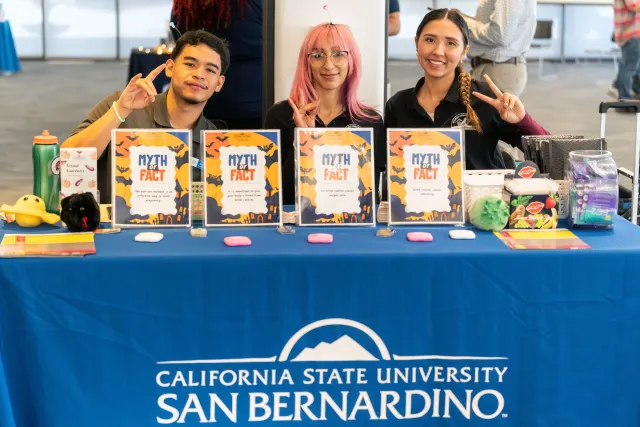
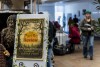
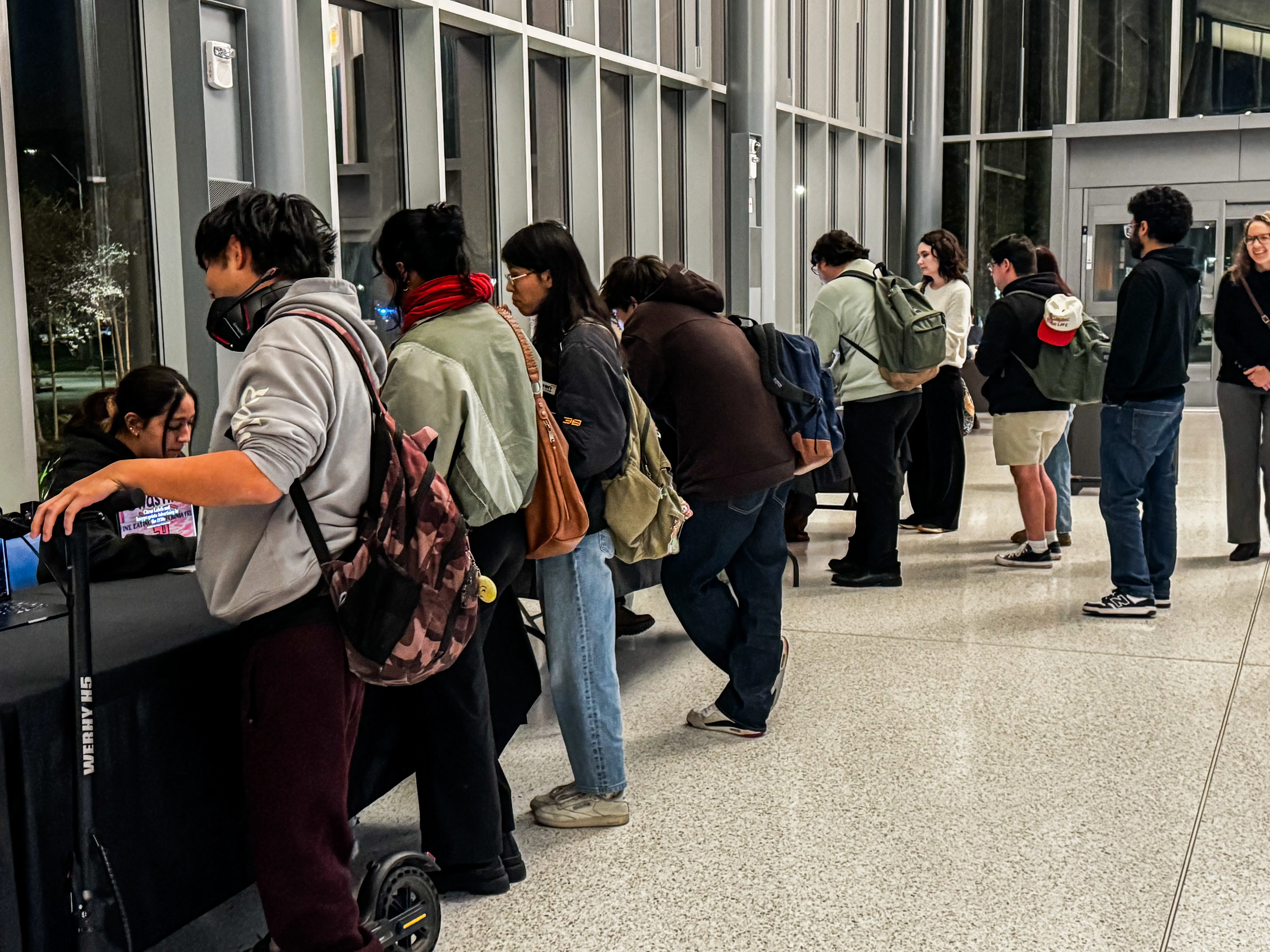
On Nov. 24, students from three sections of ENG 1070A, an accelerated first-year composition course taught by Dr. Jasmine Lee and Dr. Thomas Girshin, gathered in the lobby of the Performing Arts Center for “Amplifying History,” a public showcase of six weeks of archival research and digital storytelling. According to Lee, the showcase was the first of its kind on campus.
The project grew out of a grant Lee secured through the CSU Adobe for All partnership, an initiative that provides CSU students with access to Adobe tools. Lee developed the course around the idea of using digital storytelling to share stories that matter to the communities surrounding the university.
Before students began exploring the archives, they examined how the Inland Empire is represented by sources outside the region, including coverage from the Los Angeles Times and a PBS documentary about the warehouse industry. Students considered how stories are framed, how images influence perceptions and whether those representations reflect their own experiences.
In Lee’s section, all but two students were from the Inland Empire.
“They know this place. They live in this place.” Lee said.
Recognizing the differences between their lived experiences and some of the narratives told about their communities provided a starting point for students to explore what other stories the region had to offer.
Working with the University Archives and Special Collections, students examined historical documents, photographs, newspaper articles and other materials before identifying subjects they wanted to investigate further.
Lee encouraged students to consider which discoveries they were most excited to share with others.
“What did you want to go home and tell your roommate or your parent or your friend about?” Lee said. “Because that might be a story that has legs.” For mathematics major Skye Harris, finding that story initially seemed like an overwhelming assignment.
“This assignment at first seemed kind of like an impossible task, because they were making us look for something that hasn’t been told,” Harris said. “I’m like, how are you going to find something that hasn’t been told?”
Harris began working her way through archived editions of the Coyote Chronicle. She discovered a front-page article titled “Walk for Peach” in the Oct 31, 1984 edition.
Written by Chronicle reporter Nicole DuCharme, the article documented an eight day walk from Riverside to Los Angeles by Salvadoran refugees and their supporters to raise awareness of conditions in Central America and the treatment of refugees in the United States.
The story’s relevance today caught Harris’ attention, prompting her to extend her research beyond CSUSB’s archives to UC Riverside and other historical newspaper collections.
“As a math major, I was like, let me be analytical here, and I dove, and I didn’t pull back,” Harris said.
What began as a required assignment became something she looked forward to working on in class.
“I didn’t think I was going to be this passionate about this project because I’m like, it’s just a final project,” Harris said.
For Ishmael Perez, a business administration major with a concentration in marketing, the university’s own history offered an unexpected discovery. His project explored the life of Nikolai Khokhlov, a former Soviet intelligence officer who defected to the West in 1954 after refusing to carry out an assassination.
After surviving a Soviet poisoning attempt in 1957, Khokhlov eventually earned a doctorate in psychology from Duke University. He taught psychology at CSUSB from 1968 to 1992, served as a department chair and became professor emeritus in 1993. His personal papers are now preserved at Stanford University’s Hoover Institution.
For Perez, the unexpected connection between the Cold War espionage and his own university was enough to motivate him to investigate further.
“That was really interesting to me. So that’s what kind of motivated me to pick the story,” Perez said.
Other students explored the citrus industry’s influence on the Inland Empire, regional civil rights movement and the history of a local blacksmith whose life intersected with several aspects of early California history.
While the subjects varied considerably, students worked through many of the same processes found in traditional composition courses, including organizing research, developing narratives and completing multiple rounds of revision based on feedback from faculty and classmates.
They also had to consider how photographs, historical documents, and visual design could complement their writing. Using an Adobe digital storytelling template developed by Lee, students assembled their findings into projects intended for audiences beyond the classroom.
During her opening remarks, Lee acknowledged the amount of work students had accomplished in just sex weeks.
“To get where they are today, these students have had to learn an entirely new research methodology, immerse themselves in our campus archives, identify meaningful stories, corroborate the information that they discovered through additional research, and wrangle all their findings into a meaningful and engaging story,” Lee said.
Lee and Girshin have also discussed adapting the project into a graduate seminar for students pursuing the rhetoric and composition track with the English department.
For Harris, however, the experience had already changed what she expected from a required first-year writing course.
“I think that it made me want to learn,” Harris said.